

Plywood vs MDF vs Particle Board: Which Material Works Best for Kitchen Cabinets?
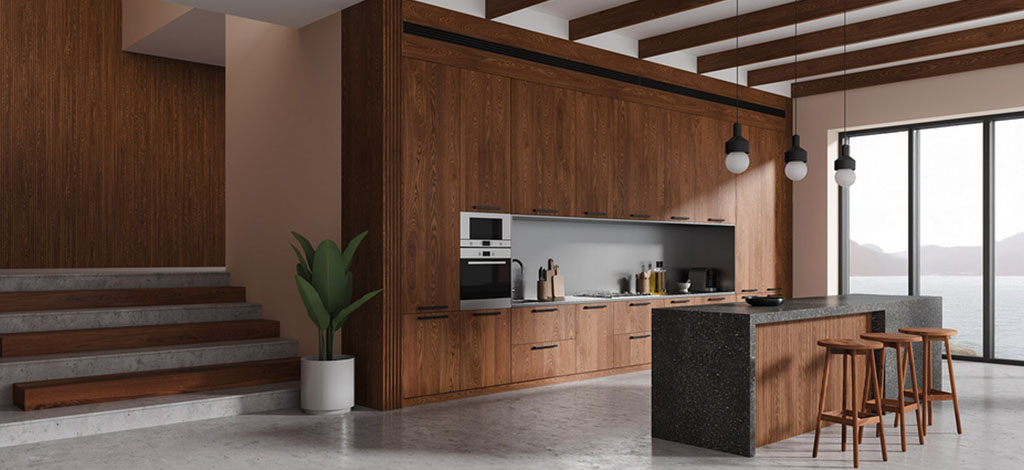
When planning kitchen cabinets, common material choices include plywood, MDF and particle board, and on the surface, they can seem fairly similar. However, once in use, the differences start to show up. Some materials are manufactured to handle moisture and daily wear, while others may begin to show signs of strain over time. In this article, we’ll take a closer look at how each material performs, helping you understand the differences and make an informed choice for your kitchen. Let’s start by understanding what this material will be expected to withstand.
Related: Designing Modular Kitchens with the Best Plywood in India: Applications & Material Guide
Challenges Kitchen Cabinets Must Withstand
Before comparing materials, it is important to understand the conditions kitchen cabinets are exposed to on a daily basis. Kitchens bring together moisture, heat and constant usage, all of which directly affect how different materials behave over time.
Some of the key challenges that impact cabinet materials include:
- Moisture exposure: Cabinets near sinks and lower units are often exposed to water and humidity, which can lead to swelling or weakening of the core.
- Heat and steam: Continuous exposure to heat and steam, especially around cooking areas, can affect structural stability and surface integrity.
- Load-bearing stress: Cabinets are required to hold weight consistently, making strength and internal bonding critical for long-term performance.
- Screw holding and joint strength: Frequent opening and closing puts pressure on hinges and fittings, making it important for the material to retain grip over time.
These conditions often lead to issues such as swelling, loosening joints and reduced durability if the material is not suited to handle them. This makes the choice between plywood, MDF and particle board particularly important in kitchen applications.
Plywood vs MDF vs Particle Board: A Quick Overview
Before comparing how these materials perform, it helps to understand how each one is constructed. The way a material is built directly influences its strength, stability and overall behaviour over time.
Plywood
Plywood sheets are manufactured by bonding multiple thin layers of wood veneers together under heat and pressure. Each layer is placed with its grain direction perpendicular to the next (cross-grain construction), which improves strength and reduces the chances of warping. High-quality ply board is typically made using hardwood veneers and bonded with thermosetting resins, resulting in a dimensionally stable and load-bearing sheet material with improved resistance to bending and splitting.
MDF
Medium Density Fibreboard (MDF) is made by breaking down wood into fine fibres, which are then combined with synthetic resin binders and additives such as wax for moisture resistance. This mixture is formed into panels under high temperature and pressure, creating a dense, uniform and isotropic board (consistent in all directions). The absence of natural grain gives MDF a smooth, consistent surface suited for precision finishes.
Particle board
Particle board is produced using wood chips, sawdust and small wood particles mixed with resin. This mixture is compressed into sheets under heat and pressure to form a relatively less dense and less uniform structure compared to MDF. The internal bonding strength is lower due to larger particle size and voids within the core structure, which influences how the board performs under load and stress.
Performance Comparison in Kitchen Conditions
Once installed, materials behave very differently under everyday kitchen conditions. Factors such as moisture exposure, heat, load and repeated usage directly impact how cabinets hold up over time. Understanding how plywood sheets, MDF and particle board perform across these conditions helps in making a more informed choice.
To compare them effectively, here is how each material responds to key performance factors:
- Moisture resistance: Kitchens involve constant exposure to water and humidity, especially around sinks and base units. Plywood sheets perform better due to their cross-laminated structure and stronger bonding, which slows down moisture ingress. MDF tends to swell when exposed to prolonged moisture, while particle board is more susceptible to water absorption and structural breakdown.
- Heat tolerance: Areas near the hob or oven are exposed to continuous heat and steam. Ply board maintains its structural integrity under typical kitchen heat conditions, whereas MDF can weaken over time, and particle board may lose bonding strength when subjected to sustained heat.
- Load-bearing capacity: Cabinets often support the weight of utensils, appliances and stored items. Plywood sheets offer higher strength due to layered construction, making them suitable for shelves and base units used to store utensils or appliances. MDF can handle moderate loads but may sag over time, while particle board has comparatively lower load-bearing capacity.
- Screw holding strength: Hinges and fittings rely on strong screw retention. Ply board provides better grip due to its layered structure, allowing screws to hold firmly over repeated use. MDF offers moderate holding strength, while particle board tends to loosen more quickly with frequent opening and closing.
- Resistance to warping and dimensional stability: Changes in humidity and temperature can affect shape and alignment. Plywood sheets are more dimensionally stable due to cross-grain construction, reducing the risk of warping. MDF remains stable in dry conditions but is sensitive to moisture, while particle board is more prone to deformation under fluctuating conditions.
- Edge integrity and durability: Edges are particularly vulnerable in kitchen cabinets. Plywood sheets tend to maintain edge strength better, while MDF edges can be prone to chipping if not handled carefully. Particle board edges are more fragile and can deteriorate faster with wear.
- Internal bonding strength: The internal bonding of a material affects how well it holds together under stress. Plywood sheets benefit from layered construction and strong adhesives, offering better internal cohesion. MDF has uniform bonding but lower structural strength, while particle board is more prone to internal separation due to its coarser composition.
- Long-term durability under repeated use: Kitchen cabinets are subject to continuous opening, closing and load shifts. Ply board maintains structural integrity over time, whereas MDF may show gradual weakening in high-use areas, and particle board tends to deteriorate faster under repeated stress.
Surface Compatibility and Design Flexibility
Beyond structural performance, the ability of a material to support finishes plays a key role in how kitchen cabinets look and come together visually. Different materials respond differently to laminates, veneers and other surface treatments, which directly impacts design flexibility and finish quality.
Here is how each material performs from a surface compatibility perspective:
- Compatibility with laminates and veneers: Plywood sheets provide a stable base for laminates and veneers, allowing finishes to adhere reliably when properly pressed and bonded. This makes them a dependable choice for achieving consistent kitchen plywood designs. MDF also supports laminates effectively due to its smooth surface, while particle board can face limitations due to its relatively lower surface density and internal structure.
- Surface smoothness and finish quality: MDF offers a naturally smooth and uniform surface, making it suitable for painted or high-gloss finishes when kept in controlled conditions. Ply board, while slightly textured due to its layered construction, works well with laminates, veneers and other surfacing options.
- Edge finishing and detailing: Clean edge finishing is important for visible cabinet elements. Plywood sheets generally maintain better edge integrity compared to particle board, allowing for more consistent finishing with laminates or edge bands. MDF edges can be finished smoothly but require careful handling to avoid damage.
Cost Considerations and Long-Term Value
Material cost is often one of the first factors considered when planning kitchen cabinets, but the initial price does not always reflect long-term value. Understanding how different materials compare in terms of cost and lifecycle helps avoid frequent repairs and replacements.
Here is how the three materials typically compare:
- Initial cost hierarchy: Particle board is generally the most economical option, MDF sits in the mid-range, while plywood sheets tend to be priced higher. This variation in plywood sheet price reflects differences in raw materials, manufacturing complexity and structural quality.
- Cost vs durability over time: Particle board, while economical, may be more susceptible to wear in demanding conditions. MDF offers moderate durability but can be affected by prolonged exposure to moisture. Plywood sheets, on the other hand, are often more stable over time, which can reduce the likelihood of early repairs or replacement.
- Maintenance and repair considerations: Particle board may require more frequent attention due to potential weakening or edge damage, while MDF may need careful handling in areas exposed to moisture. Ply board generally performs more consistently under regular use, resulting in comparatively lower maintenance needs.
- Replacement frequency and lifecycle value: Cabinets made from particle board may need earlier replacement in high-use areas, while MDF can offer moderate longevity depending on usage conditions. Plywood sheets are typically associated with longer service life, which can translate into better value over the lifecycle of the installation.
Key Differences at a Glance
To bring all the key factors together, the table below compares how plywood sheets, MDF and particle board perform across the parameters that matter most for kitchen cabinets.
| Factor | Ply Board | MDF | Particle Board |
| Moisture resistance | High (with appropriate grade) | Low to moderate | Low |
| Heat tolerance | Stable under typical kitchen conditions | Moderate | Lower |
| Load-bearing capacity | High | Moderate | Low |
| Screw holding strength | Strong | Moderate | Weak |
| Dimensional stability | High | Stable in dry conditions | Prone to swelling and deformation |
| Edge durability | Good | Smooth but can chip if mishandled | Fragile |
| Internal bonding strength | High | Moderate | Low |
| Long-term durability | High | Moderate | Low |
| Surface compatibility | Good for laminates, veneers and other surfacing options | Excellent for paint and smooth finishes | Moderate (depends on density and finish) |
| Initial cost | Higher | Mid-range | Lower |
| Lifecycle value | Higher | Moderate | Lower |
While MDF and particle board can be suitable for certain controlled or low-exposure applications, plywood sheets are generally considered a more dependable option for kitchen cabinets due to their balanced performance across strength, moisture resistance and long-term durability.
Related: Smart Ideas for Better Kitchen Cabinet Selection
About Mikasa Plywood
Mikasa Plywood offers a comprehensive range of engineered wood solutions designed for strength, consistency and long-term performance. Our portfolio includes high-performance plywood such as Sapphire, Marine Blue, Marine, BWP+, MR+ and Fire Guardian, along with blockboards like Marine Blue Blockboard, BWP+ Plus Blockboard and MR+ Plus Blockboard. Each product is manufactured using advanced processes and quality-controlled bonding systems to ensure consistent durability across varied applications, from furniture and cabinetry to more demanding environments.
As a top plywood brand in India, Mikasa Plywood supports confident material selection for homes and commercial spaces where reliability matters. You can call us at 1800 833 0004 or write to info@mikasaply.com to discuss your requirements. For a tailored response, simply fill out our contact form and a representative will connect with you promptly.